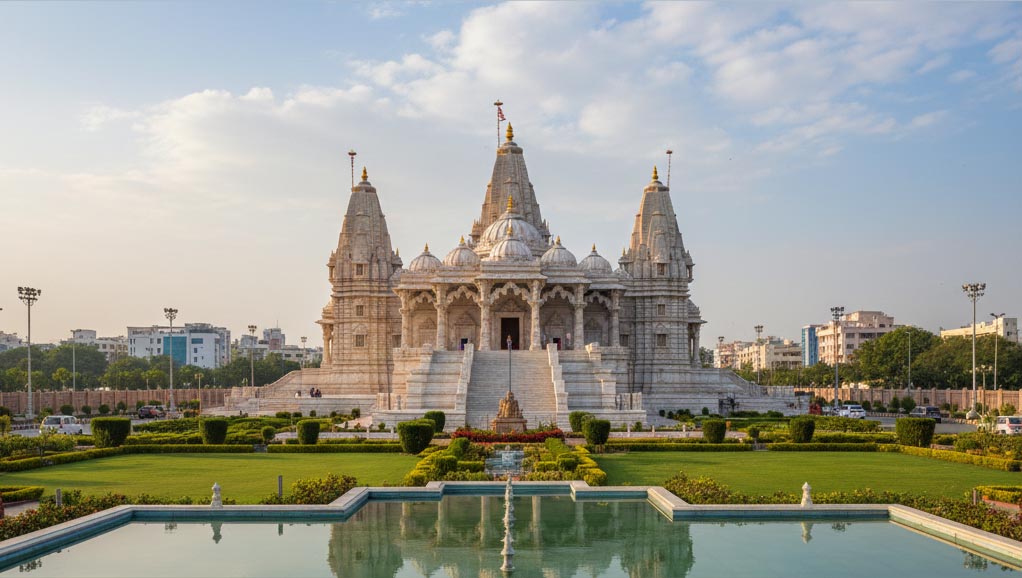
The BAPS Shri Swaminarayan Mandir, a magnificent edifice nestled in the western fringes of Pune, specifically in the Narhe suburb along the Mumbai-Bengaluru National Highway (NH 48), stands as one of the 21st century's most compelling examples of spiritual and architectural preservation. Inaugurated in February 2017, this temple, managed by the Bochasanwasi Shri Akshar Purushottam Swaminarayan Sanstha (BAPS), is far more than a place of routine worship; it is a profound cultural center, an engineering marvel constructed without steel, and a significant catalyst for the real estate boom in the surrounding South Pune corridor.
📜 Section I: Historical and Spiritual Foundation
The existence of the BAPS Shri Swaminarayan Mandir in Pune is rooted in the rich lineage and core philosophy of the Swaminarayan Sampraday, an independent Hindu denomination with a strong emphasis on devotion, ethics, and selfless community service.
The Swaminarayan Sampraday and BAPS
The movement originated with Bhagwan Swaminarayan (born Ghanshyam Pande, 1781–1830) in late 18th-century Gujarat. His teachings emphasized a life guided by five core vows. His theological understanding is encapsulated in the Akshar-Purushottam Upasana, which posits:
- Purushottam: The Supreme God (Bhagwan Swaminarayan).
- Aksharbrahman: The ideal devotee and eternal abode of God, manifested on Earth as the Satpurush (Living Guru), who serves as the medium through which one can attain salvation.
The BAPS organization itself was formally established in 1907 by Brahmaswarup Shastriji Maharaj (1865–1951) in the village of Bochasan, solidifying the philosophical distinction of Akshar being separate from and superior to the aspirant soul.
The Guru Parampara (Spiritual Lineage)
The Pune Mandir, like all BAPS centers, is a testament to the dedication of the spiritual successors who followed Shastriji Maharaj:
- Yogiji Maharaj (1892–1971): The second spiritual successor, who significantly expanded the Sanstha's youth and children's activities.
- Pramukh Swami Maharaj (1921–2016): The fifth spiritual successor, known as the architect of modern BAPS. The Pune Mandir was conceived and commenced under his guidance.
- Guruhari Mahant Swami Maharaj (Current Spiritual Head): The sixth and current spiritual head, who consecrated and officially opened the Pune Mandir in February 2017.
The Mandir complex serves as a living symbol of these teachings, offering devotees a tangible connection to the spiritual lineage and inspiring them to lead morally disciplined lives.
🏗️ Section II: Architectural Excellence and Construction Science
The BAPS Shri Swaminarayan Mandir in Pune is renowned as a contemporary masterpiece of traditional architecture. Its design rigorously follows the principles laid out in the Shilpa Shastras and the Vastu Shastras.
The 'Steel-Free' Marvel
The most defining and awe-inspiring characteristic of the structure is its method of construction:
- Absence of Ferrous Metals: The entire temple was built without the use of structural steel or iron reinforcement. This is a deliberate choice consistent with ancient temple construction for two primary reasons:
- Longevity: Stone offers superior durability, ensuring the structure can stand for a thousand years or more.
- Spiritual Purity: Ancient texts suggested that ferrous metals could potentially impede deep spiritual meditation.
- The Stone Puzzle: The temple, measuring approximately 184.6 ft (Length) $\times$ 181.6 ft (Width) $\times$ 74.6 ft (Height) and covering 33,523 square feet, is essentially a giant, self-load-bearing, three-dimensional jigsaw puzzle.
- Materials: Constructed primarily from high-quality Indian pink sandstone and red stone procured from Rajasthan.
- Carving Process: Over 10,000 intricately hand-carved stone pieces were precisely interlocked on-site using time-honored techniques of dowels and pins.
Design and Iconography
The Mandir exemplifies the Nagara-style architecture (predominant in North and West India).
- Intricate Details: The temple rests upon 140 richly carved pillars and is adorned with 109 ornate Torans (arched gateways). The vast surface area is covered by over 10,269 sculptures and relief carvings.
- Visual Narrative: The iconography narrates the Hindu pantheon and the life stories of Bhagwan Swaminarayan. The carvings meticulously integrate Marathi and regional cultural motifs.
- Shikhars and Samrans: The temple features a striking roofline defined by 23 Samrans (domed structures).
- The Garbhagriha: The inner sanctum houses the sacred images (murtis) of the main deities, consecrated through the prana pratishtha ceremony.
🧘 Section III: Worship, Cultural Preservation, and Community Outreach
Beyond its architectural splendor, the Pune Mandir operates as a functional spiritual and humanitarian center, reflecting the BAPS ethos of seva (selfless service).
Daily Spiritual Practices
Devotional activities are structured around fixed daily schedules:
| Ceremony |
Time |
Significance |
| Shangar Aarti |
7:30 AM |
Ritual dressing and ornamentation of the deities. |
| Rajbhog Aarti |
11:15 AM |
Offering of the mid-day meal to the deities. |
| Sandhya Aarti |
7:00 PM |
The major evening service, performed at sunset, accompanied by devotional singing. |
| Shayan Aarti |
8:30 PM |
The ritual of putting the deities to rest for the night. |
| Murti Darshan (General Viewing) |
7:00 AM – 12:00 PM & 4:00 PM – 8:30 PM |
The general time window for visitors to view the sacred images. |
- Abhishek Mandapam: A ritual area where devotees can perform Abhishek—ceremonially bathing the idol of Neelkanth Varni with water. This practice is open to all visitors.
- Weekly Assemblies (Sabha): The Mandir organizes weekly spiritual assemblies (Ravi Sabhas) for all age groups to study Hindu scriptures and receive discourses.
Social and Cultural Impact
The BAPS Mandir is not merely a destination but a catalyst for positive change in the region, involved in various community upliftment initiatives:
- Humanitarian Services: Coordinating disaster relief, organizing frequent free medical check-up camps, blood donation drives, and health awareness programs.
- Cultural Preservation: Through exhibitions and programs, the Mandir actively promotes and preserves traditional Indian arts, music, dance, and philosophical thought.
Visitor Experience and Facilities
The complex is designed for visitor comfort and spiritual focus:
- Premvati Food Shop: Offers a selection of fresh, hygienic, and traditional vegetarian and Jain cuisine.
- Aksharpith Book Store: Provides a rich collection of spiritual literature and cultural gift items.
- Atmosphere: The temple grounds provide a peaceful and contemplative retreat from the urban clamor.
🏘️ Real Estate and Locality Analysis: South Pune Corridor
The BAPS Shri Swaminarayan Mandir acts as a major landmark for the surrounding areas of Narhe and Ambegaon Khurd (Kh), which have emerged as significant residential hotspots due to their strategic location on the Mumbai-Bengaluru Highway (NH 48/Katraj Bypass) and relatively affordable property rates compared to Central Pune.
Key Residential Localities
The primary residential zones immediately surrounding the temple include:
Ambegaon Khurd (Kh):
- Character: Sits on the fringe of the highway and features more hilly terrain, offering some projects with natural scenic views.
- Connectivity: Well-connected to the highway and easily accessible to the facilities of Katraj.
- Property Type: Sees many multi-storey apartment complexes, mainly focusing on 1 BHK and 2 BHK flats.
- Price Trend: The average property price is generally lower than its immediate neighbors, making it highly attractive to first-time homebuyers. The area has seen a healthy appreciation in property rates.
Narhe (Narhe Gaon):
- Character: The closest locality, offering a mix of established residential societies and numerous new projects. It's considered an affordable and mid-segment residential area.
- Connectivity: Excellent access to the NH 48, providing swift connections to Satara Road, Katraj, and IT hubs like Hinjewadi via the bypass.
- Property Type: Predominantly multi-storey apartments, mainly focusing on 1 BHK and 2 BHK flats.
Dhayari:
- Character: Located slightly west, a large, developing residential area connected via the Narhe-Dhayari Road.
- Connectivity: Provides good access to the highway and connects further towards Sinhagad Road.
Vadgaon Budruk:
- Character: Situated closer to the Katraj end of the highway, a well-established area with excellent infrastructure.
- Connectivity: Benefits from proximity to educational institutions and the main Katraj junction.
Real Estate Investment Snapshot (General Trends)
The southern peripheral localities of Pune, especially the ones near the temple, are driven by the following factors:
- Affordability: Offer residential options at significantly lower capital values than central or eastern Pune IT corridors (like Koregaon Park, Kharadi, Hinjewadi, Wagholi, Tathawade, Poonawale, Bavdhan etc.).
- Connectivity: Direct access to the Mumbai-Bengaluru Highway (NH 48) and the Pune-Satara Road is a major draw.
- Infrastructure: The development of the Katraj-Dehu Road Bypass and the planned Pune Ring Road is expected to further boost the connectivity and, consequently, the real estate appreciation in these areas.
- Demand: Primarily fueled by:
- IT Professionals (via the bypass)
- Students/Faculty (due to proximity to major educational institutes like the Sinhgad College campus)
- Industrial Workforce
The presence of the monumental BAPS Swaminarayan Mandir adds a layer of cultural and spiritual value to the locality, which is often considered a positive factor for residential living, contributing to the area's development and attracting long-term residents.

 Dnyandeep Heights